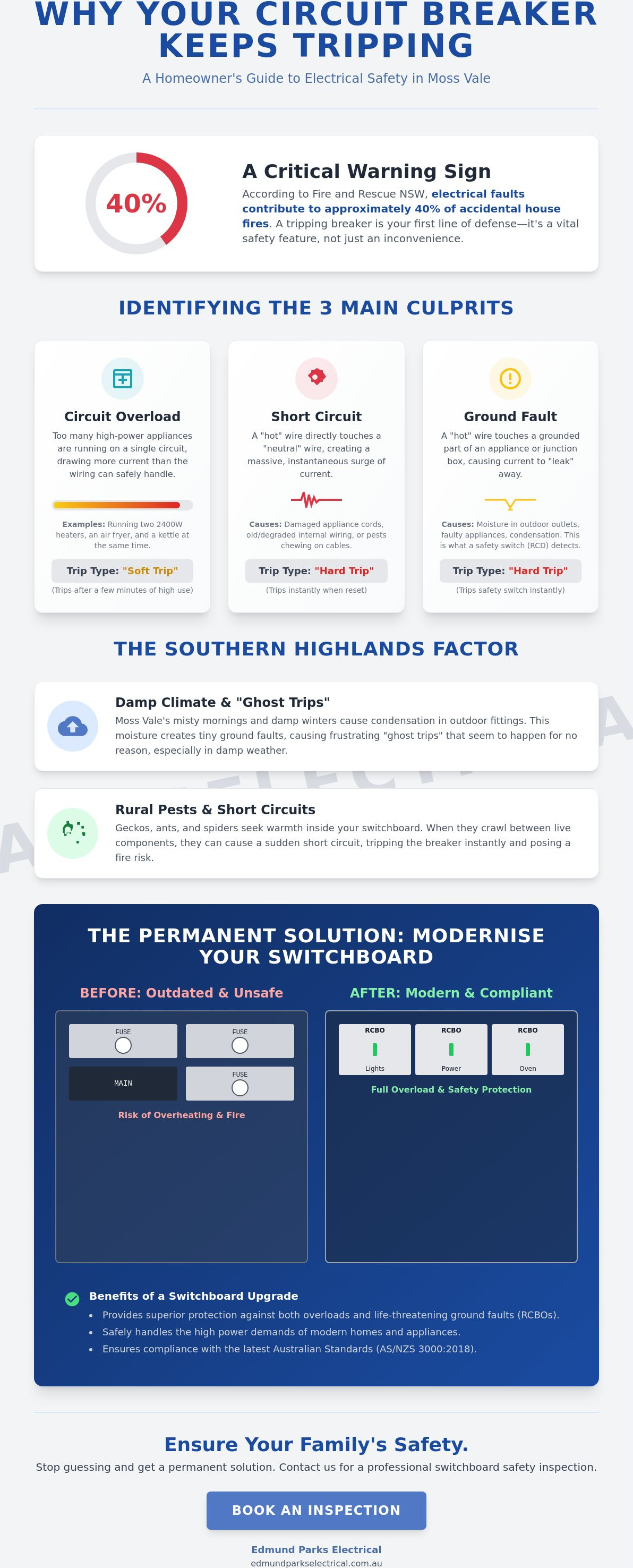
Did you know that electrical faults contribute to approximately 40% of accidental house fires according to Fire and Rescue NSW? When your circuit breaker keeps tripping Moss Vale, it’s rarely just a random glitch. It’s a vital safety mechanism telling you that something is wrong. We understand how frustrating it is to deal with unexpected blackouts during a cold Southern Highlands winter, especially when you’re worried about the food in your fridge or the underlying risk of an electrical fire.
You don't have to guess what's happening behind your walls. This guide promises to help you discover exactly why your power keeps cutting out and how to safely restore it using our local expertise. We’ll look at common culprits like overloaded circuits and outdated wiring. We will also explain how modern solutions like safety switch installation or switchboard upgrades keep your home compliant with the latest Australian Standards. This ensures your family stays safe and your power stays on so you can get back to your day without the stress.
Key Takeaways
- Understand that a tripping breaker is a vital safety feature designed to protect your home's wiring from overheating and fire risks.
- Identify the specific differences between circuit overloads, short circuits, and ground faults to determine if you need professional help.
- Discover why your circuit breaker keeps tripping Moss Vale even when the house is quiet, often due to accumulated earth leakage.
- Follow a safe, logical troubleshooting sequence during a blackout to restore power without touching dangerous internal components.
- Learn how modern switchboard upgrades and RCBOs provide a permanent solution for the high power demands of modern regional living.
Why Your Circuit Breaker Keeps Tripping in Moss Vale
It is a cold winter evening in the Southern Highlands and suddenly the lights go out. Again. If your circuit breaker keeps tripping Moss Vale, you aren't alone. Many residents in our local community face this exact issue, especially in some of the more established homes. It’s easy to feel frustrated when your routine is interrupted, but remember that a trip isn't a failure of the system. It is actually the system working exactly as intended to keep you safe. A tripping switch is the first line of defense against electrical fires and damaged appliances.
Think of the device as a vigilant bodyguard for your home's internal wiring. To understand what is a circuit breaker, you have to look at its primary job: monitoring the flow of electricity. When it detects an unsafe level of current that could heat up your wiring and cause a fire, it shuts everything down instantly. It’s a safety mechanism, not a broken switch. In Moss Vale, we often see older infrastructure struggling to keep up with modern lifestyle demands. We use more high-powered heaters, air conditioners, and kitchen appliances than these homes were ever designed to handle. When you plug in that extra heater on a frosty night, the bodyguard steps in to prevent a disaster.
The Moss Vale Climate Factor
Moss Vale is famous for its misty mornings and damp winters. While beautiful, this moisture can wreak havoc on your electrical system. We often find that older cottages near Argyle Street or Lackey Road have external power points or light fittings that aren't perfectly sealed. Condensation builds up inside these enclosures during rapid temperature shifts. This moisture creates a bridge for electricity to escape. If your circuit breaker keeps tripping Moss Vale specifically during damp weather, the Highlands climate is the likely culprit. It causes a "ghost trip" that seems to happen for no reason at all, but it actually indicates a seal has failed on an outdoor fitting.
Rural Pests and Your Switchboard
Living in a rural area means sharing our space with local wildlife. Unfortunately, geckos, ants, and spiders love the warmth generated by your electrical board. They crawl into the small gaps of your switchboard or sub-boards, seeking shelter from the cold Highlands nights. When a critter bridges the gap between two live components, it causes a short circuit. You might notice a faint smell of burning or see small debris around the enclosure. This is a common challenge for rural electrical services. Wildlife-related wear and tear is much higher here than in the city, requiring specific enclosures or safety switch installation to keep the system resilient against these tiny intruders.
Identifying the Culprit: Overloads, Short Circuits, and Ground Faults
To fix the problem, you first need to identify which type of fault is occurring. Your switchboard contains different components. Some are Miniature Circuit Breakers (MCBs) while others are Residual Current Devices (RCDs), also known as safety switches. If your circuit breaker keeps tripping Moss Vale, it's usually one of three culprits. Understanding the timing of the trip helps you decide if you can solve it by unplugging a toaster or if you need to call in a professional.
Pay close attention to how the switch behaves. A "hard" trip happens the millisecond you flip the switch back to the "on" position. This usually signals a short circuit or a serious ground fault. A "soft" trip is different. It might take several minutes of running an appliance before the power cuts out. This suggests an overload where the wiring is gradually heating up. All modern electrical work in Australia must adhere to AS/NZS 3000:2018, known as the Wiring Rules. These standards ensure your components react correctly before a fire starts. Following official safety precautions is vital when you're trying to figure out which switch is the problem.
Circuit Overload: Too Many 'Toys' on One Line
In 2026, our Moss Vale homes are under more pressure than ever. We've added high-draw appliances like air fryers and electric vehicle (EV) chargers to circuits originally designed decades ago. During a local winter, the strain peaks. Plugging in two portable 2400W heaters on the same circuit will almost certainly cause a trip. If your power cuts only when specific high-energy items are running, you likely have too much amperage on one line. You might need to spread the load across different rooms or consider a switchboard upgrade to handle the modern demand safely.
Short Circuits and Ground Faults
These are the more serious faults that require immediate attention. A short circuit happens when a "hot" wire touches a neutral wire. This creates a path of least resistance, causing a massive, instant surge of current. A ground fault is similar but occurs when the "hot" wire touches the ground wire or a metal component, often due to water ingress or frayed insulation. Both are dangerous because they can cause sparks and intense heat. If you reset the breaker and it pops back immediately with a loud "snap," don't try again. These issues require a licensed professional to locate the fault and perform a safety switch installation or repair to keep your family protected.
The 'Ghost Trip': Why Breakers Flip When Nothing is On
It is 10:00 PM and the house is quiet. You are reading a book or getting ready for bed when suddenly the power cuts. No heaters were running and the kettle wasn't on. This is what we call a "ghost trip." It is one of the most frustrating issues a homeowner can face because there is no obvious cause. If your circuit breaker keeps tripping Moss Vale residents often assume the switch itself is broken. Usually, the switch is just doing its job. It is reacting to something called earth leakage that is happening silently in the background.
Earth leakage is a tiny amount of electricity that escapes from a circuit to the ground. Almost every modern appliance has a very small amount of "background" leakage. On their own, a single lamp or a clock radio isn't a problem. However, when you have a smart TV, a Wi-Fi router, three laptop chargers, and a microwave all plugged in, those tiny leaks add up. This is cumulative leakage. Your safety switch is designed to trip when it detects a leakage of about 30 milliamps. If your total background leakage sits at 25 milliamps, even a tiny surge from a phone charger can push it over the limit. Professional essential electrical services use specialized insulation resistance testers to find these invisible leaks before they shut down your whole night.
Standby Mode and Smart Home Tech
In 2026, our homes are filled with "always-on" devices. Smart home hubs, security cameras, and Wi-Fi routers never truly sleep. These devices use switch-mode power supplies that naturally leak small amounts of current as they operate. Cheap power boards are another common culprit. They often lack proper internal shielding and can degrade over time. We also see issues with modern LED drivers. While LED strip lighting is a great energy-efficient choice, poor-quality drivers can cause electrical noise or interference on older circuits. This noise tricks the safety switch into thinking there is a genuine fault. If your circuit breaker keeps tripping Moss Vale houses with older wiring are especially susceptible to this electronic clutter.
Moisture in Outdoor Circuits
Moss Vale is famous for its thick morning mist and lush gardens. This beauty comes with a hidden cost for your electrical system. Garden lighting, pond pumps, and outdoor power points are exposed to the Southern Highlands elements every day. Even if you aren't using your outdoor lights, moisture can seep into the fittings. This creates a bridge for electricity to leak into the earth. It only takes a damp morning or a heavy frost to trigger a safety switch. We recommend checking that all outdoor components have a high IP (Ingress Protection) rating. For rural properties, these weather-rated enclosures are essential. They keep the mist out and your power on.
Step-by-Step: What to Do When the Power Goes Out
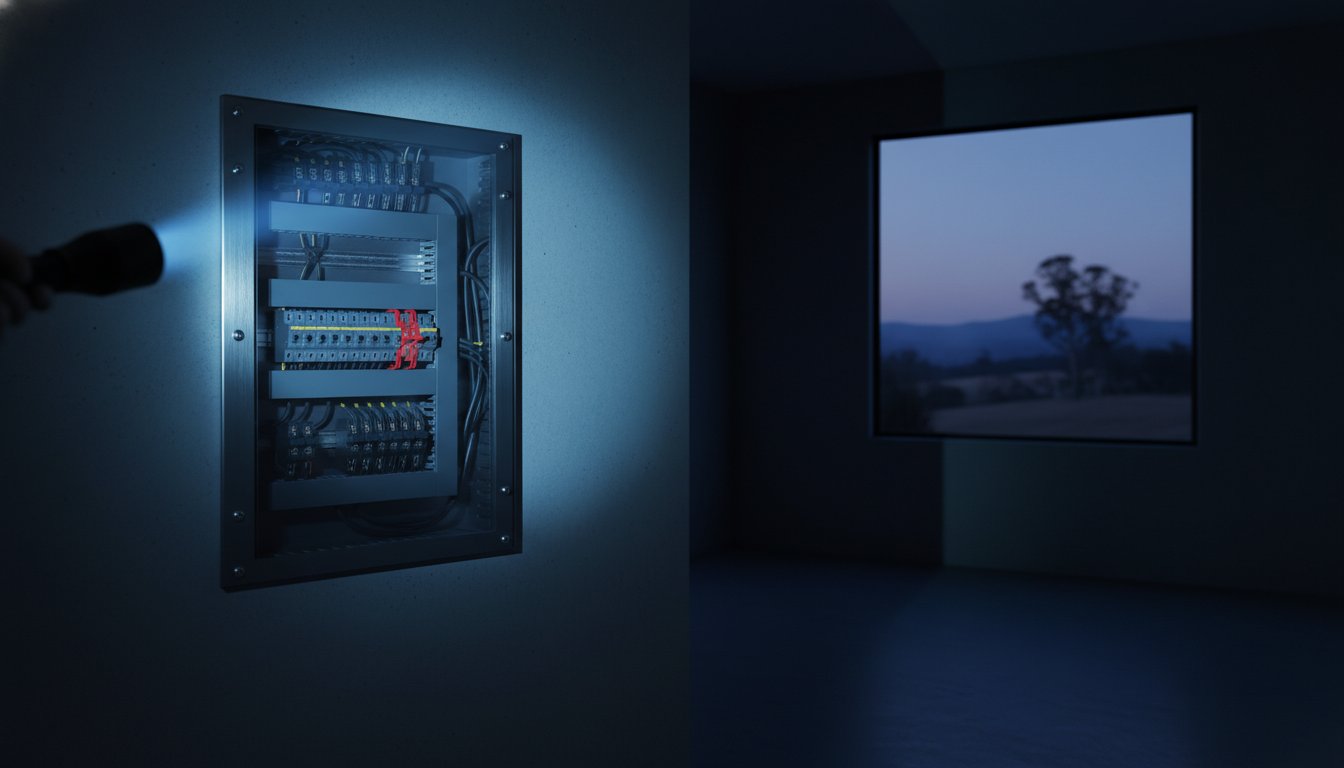
When your power suddenly cuts, it's natural to feel a bit of panic. Maybe you were halfway through cooking dinner or finishing a project on your computer. Before you grab a torch and head to the switchboard, take a deep breath. Safety is the absolute priority here. We always recommend the "hands-in-pockets" rule. This means you should only ever touch the plastic switches on the outside of your board. Never attempt to remove the cover, poke anything inside the enclosure, or touch exposed wires. If your circuit breaker keeps tripping Moss Vale homes often just need a simple diagnostic check that you can perform yourself to find the source of the trouble.
The Process of Elimination
Most tripping issues are caused by a faulty appliance rather than the house wiring itself. Follow these three steps to find the culprit:
- Step 1: Unplug everything. Go to the area of the house that lost power. Unplug every single device from the wall sockets. Don't just turn them off; physically pull the plugs out. This includes kettles, toasters, and even phone chargers.
- Step 2: Reset the breaker. Head to your switchboard. Look for the switch that has moved to the "OFF" position. To reset it, you usually need to push it all the way down to the "OFF" position until it clicks, then flip it back up to "ON." If it stays on, you've successfully cleared the fault.
- Step 3: The plug-in test. Go back and plug your appliances in one by one. Turn each one on before moving to the next. When the power trips again, you've found your "bad" appliance.
When Resetting Fails: The Danger Signs
Sometimes the problem isn't a toaster or a heater. If you've unplugged everything and the circuit breaker keeps tripping Moss Vale residents should stop immediately. If the switch "snaps" back to the off position the moment you try to reset it, you are dealing with a "Hard Fault." This indicates a short circuit or a serious wiring issue that a homeowner cannot fix. Pushing the switch repeatedly against a hard fault can cause significant damage to your switchboard components.
Keep your senses sharp for other warning signs. If you notice a metallic, chlorine-like smell (often called ozone) or the scent of burning plastic, leave the breaker off. These are clear indicators of electrical arcing or overheating wires. You should also never, under any circumstances, use tape or a wedge to hold a circuit breaker in the "ON" position. This bypasses the safety mechanism and is a leading cause of house fires. If your DIY troubleshooting hasn't solved the problem, it's time to look at how to hire an electrician in the Southern Highlands to get a professional diagnosis. For your peace of mind and family safety, a professional electrical inspection is the only way to ensure your home remains compliant with modern safety standards.
Modernising Your Switchboard: The Permanent Solution
While the troubleshooting steps we covered can help you manage a single faulty appliance, they don't address the root cause of an aging electrical system. If your circuit breaker keeps tripping Moss Vale residents often find the real issue lies within the switchboard itself. Many of our local homes, particularly the beautiful older cottages, still rely on ceramic fuses or outdated Miniature Circuit Breakers (MCBs). These components were never designed to handle the simultaneous load of modern air conditioners, high-speed Wi-Fi routers, and induction cooktops. Upgrading to a modern system isn't just a repair; it’s a vital investment in your home’s infrastructure.
A modern switchboard ensures your home remains compliant with the latest Australian Standards. Beyond safety, an upgrade can also protect your property value. Many insurance companies now factor the age and type of your switchboard into their risk assessments. By installing modern components, you demonstrate that your home is well-maintained and safe. Edmund Parks Electrical is the local expert for switchboard upgrades in the Southern Highlands, ensuring every installation meets the highest safety benchmarks.
Why RCBOs Are the Gold Standard
Modern switchboards utilise Residual Current Breakers with Overcurrent protection, or RCBOs. These are "two-in-one" devices that offer the ultimate protection. They guard against fire by detecting overloaded circuits and prevent electrocution by instantly cutting power if they detect earth leakage. In older Moss Vale homes, one safety switch often protected multiple circuits. This meant a single fault in the laundry would turn off the lights in the kitchen and living room too. Modern boards use individual RCBOs for each circuit. This segmentation makes it incredibly easy to identify exactly where a fault is located without losing power to the rest of your house. It is the most effective way to eliminate those frustrating "nuisance" trips for good.
Future-Proofing for 2026 and Beyond
Our power needs are changing rapidly. As we move further into 2026, more homeowners are looking toward electric vehicle (EV) charging and solar integration. These technologies place a significant demand on your electrical heart. If your circuit breaker keeps tripping Moss Vale now, it certainly won't handle the addition of a high-speed car charger later. Preparing your home today prevents expensive emergency repairs tomorrow.
Real energy efficient upgrades always start at the switchboard. A professional safety audit can identify hidden issues in your wiring before they become dangerous. We take pride in helping our neighbors secure their homes with reliable, modern technology. It’s about more than just keeping the lights on; it’s about the peace of mind that comes from knowing your family is protected by a system built for the modern world.
Take Control of Your Home’s Electrical Safety
Your home’s electrical system shouldn't be a source of constant frustration. Whether it's a faulty appliance or the damp Southern Highlands mist causing issues, you now have the knowledge to identify why your circuit breaker keeps tripping Moss Vale. These safety switches are your primary defense against electrical fires. While troubleshooting can help in the short term, modernising your switchboard with RCBOs provides the permanent reliability and safety your family deserves for years to come.
Don't let electrical uncertainty linger. As fully licensed and insured NSW electricians and local Moss Vale experts since 2018, we specialize in Southern Highlands switchboard upgrades and comprehensive safety audits. We take pride in our craft and our local community. If you're ready for total peace of mind and a system that can handle modern demands, Book a Safety Check with Edmund Parks Electrical today. We'll make sure your home is safe, compliant, and ready for whatever the Highlands weather brings next. You deserve a home that works perfectly every time you flip a switch.
Frequently Asked Questions
Is it dangerous if my circuit breaker keeps tripping?
Yes, it is potentially dangerous because a tripping breaker indicates an active electrical fault. While the breaker is doing its job by cutting power, the underlying issue could be a short circuit or an overloaded wire that generates extreme heat. Ignoring the problem increases the risk of electrical fires, which account for a significant portion of accidental house fires in New South Wales.
Why does my breaker trip only when the kettle or heater is on?
This is a classic sign of a circuit overload. Kettles and portable heaters are high-draw appliances that pull a lot of current. If your circuit is already supporting lights, a TV, and a fridge, adding a 2400W heater can push the total amperage past the breaker's limit. You may need to spread your appliances across different circuits or consider a switchboard upgrade to handle the load.
Can a bad light bulb cause a circuit breaker to trip?
Yes, a failing light bulb can definitely cause a trip. When a bulb's filament breaks, it can sometimes create a momentary "arc" or a short circuit inside the bulb base. This sudden surge of electricity triggers the breaker to protect the rest of the lighting circuit. If your power trips the moment you flick a light switch, check for a blown bulb first.
What is the difference between a circuit breaker and a safety switch?
A circuit breaker is designed to protect your home's wiring and appliances from overloads and short circuits. A safety switch, or RCD, is designed to protect people from electrocution by detecting tiny leakages of electricity to the earth. Most modern Moss Vale homes now use RCBOs, which combine both of these vital safety functions into a single device.
How much does it cost to fix a tripping breaker in Moss Vale?
The cost depends entirely on the root cause of the fault, ranging from a simple loose connection to a full switchboard replacement. Most professional electricians charge a call-out fee to cover travel and initial diagnostics, followed by an hourly rate for the repair work. If your circuit breaker keeps tripping Moss Vale, a professional inspection is the only way to get an accurate quote for the specific repairs needed.
Why does my power trip during heavy rain in the Southern Highlands?
Heavy rain and mist often force moisture into outdoor electrical fittings like garden lights, pond pumps, or weather-exposed power points. This moisture creates an "earth leakage" path that triggers your safety switch instantly. Ensuring all your outdoor equipment has a high IP rating and is installed with proper weather-rated enclosures can prevent these rain-related blackouts.
Can geckos really cause my power to go out?
Geckos and other small pests are a very common cause of electrical faults in our rural region. They are drawn to the warmth of the switchboard enclosure and can bridge the gap between live electrical components. This causes a short circuit that trips the breaker instantly. We often find evidence of "critter interference" when diagnosing mysterious power failures in local sub-boards.
Should I replace my own circuit breaker if it seems loose?
No, you should never attempt to replace or tighten a circuit breaker yourself. It is illegal in Australia for anyone other than a licensed electrician to perform fixed electrical wiring work. Working inside a switchboard exposes you to live parts that can cause fatal electric shocks. If a switch feels "spongy" or loose, leave it in the off position and call a professional to perform a safe replacement.