

What if the biggest threat to your High Range acreage isn't the upcoming bushfire season, but the aging wiring hidden in your pump shed? For many landowners, electrical safety for rural properties Southern Highlands is something that only comes to mind when a fuse blows or a water pump fails during a dry spell. It's a stressful reality when you're miles from town and need a professional who actually understands the unique infrastructure demands of a large rural estate.
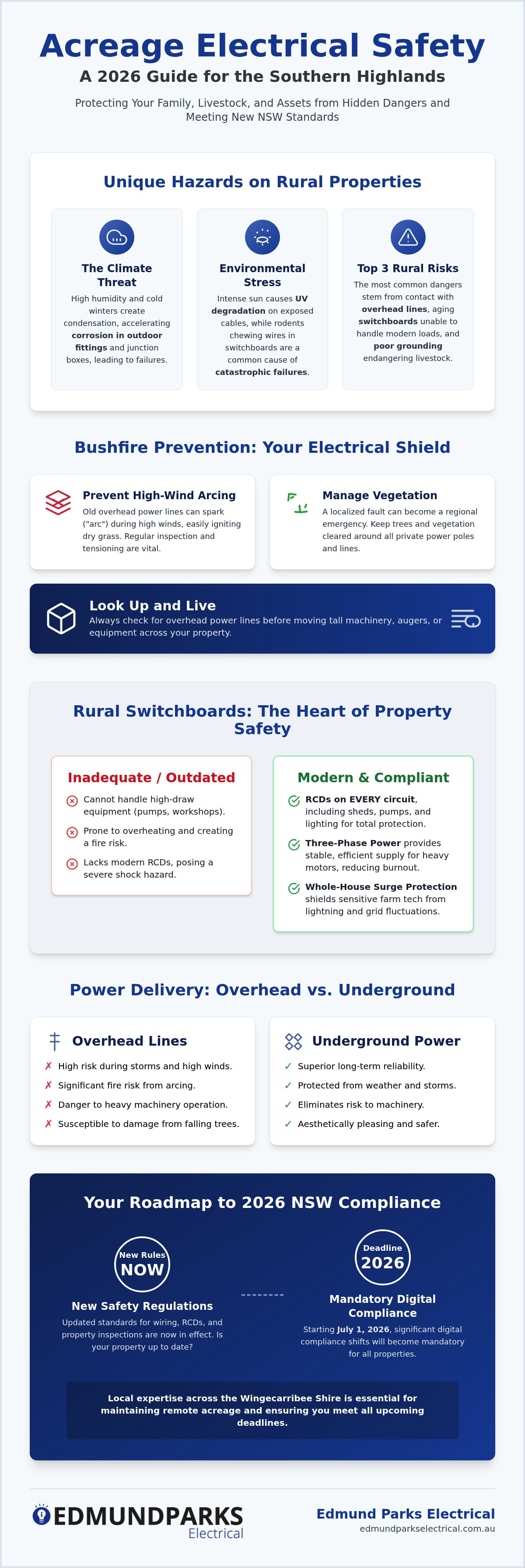
We know that living in Joadja or Kangaloon means you can't afford to wait days for a fix when your power fluctuates. You deserve the peace of mind that comes with a resilient, compliant electrical system that doesn't flicker every time the wind picks up. This 2026 guide provides the expert guidance you need to protect your family and property while meeting the latest NSW safety standards. We'll walk you through the mandatory digital compliance shifts starting July 1, 2026, the new safety regulations effective September 1, and how to ensure your sheds and essential equipment remain reliable year-round.
Key Takeaways
- Learn how the unique Southern Highlands climate accelerates hardware corrosion and why perimeter-to-perimeter inspections are vital for protecting livestock and assets.
- Discover why standard residential setups often fail and how specialized switchboard upgrades improve electrical safety for rural properties Southern Highlands by supporting high-draw farm equipment.
- Compare the long-term reliability of underground power versus the specific safety risks of overhead lines during local storms and when operating heavy machinery.
- Understand the critical safety requirements for wiring bore pumps and outbuildings, including how to prevent dangerous stray voltage in your property’s water supply.
- Get a clear roadmap for 2026 NSW compliance and why local expertise across the Wingecarribee Shire is essential for maintaining remote acreage.
Understanding Unique Electrical Hazards on Southern Highlands Acreage
Rural electrical safety is about more than just keeping the lights on. It is a perimeter-to-perimeter responsibility that protects your family, your livestock, and your expensive farm assets across large-scale infrastructure. On a Southern Highlands estate, your electrical system isn't confined to four walls; it stretches through paddocks, into pump sheds, and across workshops. Maintaining electrical safety for rural properties Southern Highlands requires a specialized approach because the risks here are vastly different from a standard suburban block.
The local climate plays a significant role in how your infrastructure ages. High humidity and biting cold winters, particularly in elevated areas like Kangaloon, create a cycle of condensation that accelerates corrosion in outdoor fittings and junction boxes. When you combine this environmental stress with the three primary rural hazards, the need for regular inspections becomes clear. Most property owners face risks from contact with overhead lines, aging switchboards that can't handle modern machinery, and poor grounding that puts livestock at risk of electric shock. Adhering to global electrical safety standards for earthing and lightning protection is the first step in mitigating these dangers on large estates.
The Impact of Regional Weather on Wiring
Persistent dampness is a constant challenge for properties in the Wingecarribee Shire. In areas prone to mist and heavy dew, moisture often finds its way into conduit runs, eventually rotting the insulation from the inside out. This isn't just a maintenance headache; it is a major short-circuit risk. We also see significant UV degradation on exposed cables in open paddocks where the sun's intensity can make PVC conduits brittle and prone to cracking in just a few seasons.
Rodent-proofing is another critical safety step that many landowners overlook. During the colder months, mice and rats seek the warmth of switchboards and pump housings, often chewing through wiring and causing catastrophic failures. Ensuring your enclosures are properly sealed and "rodent-proofed" is a simple but effective way to prevent fires in remote outbuildings.
Bushfire Prevention: Electrical Maintenance as a Shield
In the bushfire-prone regions of the Southern Highlands, your electrical maintenance acts as a vital shield. Old overhead power lines are prone to "arcing" during high-wind events, where a single spark can ignite dry grass in seconds. This risk is amplified if vegetation management around private power poles has been neglected. Keeping trees cleared and inspecting the tension of your lines can prevent a localized fault from turning into a regional emergency.
Faulty wiring in a shed or a bore pump can smolder for hours before being detected. Regular thermal imaging of your connections can identify these hot spots before they ignite. Always remember to "Look Up and Live" by checking the location of overhead power lines before moving tall machinery or augers across your property.
Rural Switchboards: The Heart of Property Safety
A rural property puts immense strain on its central electrical hub. Unlike a standard home in town, your acreage likely relies on high-draw equipment like bore pumps, shearing plants, or heavy workshop machinery. These devices pull a significant amount of current when they start up. If your switchboard is a residential-grade unit from twenty years ago, it isn't built for these loads. Ensuring electrical safety for rural properties Southern Highlands starts with a switchboard that can handle peak demands without overheating or constantly tripping.
Modern safety requires Residual Current Devices (RCDs) on every single circuit. This includes your outbuildings, external lighting, and the power supply to your cattle crushes. If a fault occurs in a remote paddock, an RCD will cut the power in milliseconds, preventing a potential fire or a fatal shock to livestock. For those running modern workshops or large-scale irrigation, we often recommend Three-Phase power. It provides a more stable and efficient supply for heavy motors, which reduces the risk of equipment burnout and saves you money on repairs in the long run.
Sensitive farm management technology also needs protection. From automated gate systems to smart irrigation controllers, modern farm tech is highly vulnerable to the power surges common in rural networks. Installing whole-house surge protection at the main board acts as a critical buffer against lightning strikes and grid fluctuations, keeping your digital assets secure. If your current setup feels outdated, a local rural electrician can help you map out a board that grows with your property.
AS/NZS 3000 Compliance for Rural Landowners
Compliance with the AS/NZS 3000 "Wiring Rules" is the benchmark for safety. For rural landowners, this often means moving away from old-fashioned ceramic fuses. These fuses are a major fire risk because they don't trip instantly under a fault and can be easily "over-fused" with the wrong wire. Modern switchboard upgrades replace these with circuit breakers and RCDs housed in weather-rated, non-combustible enclosures. This upgrade isn't just about safety; it's often a mandatory requirement for maintaining farm insurance coverage in the Wingecarribee Shire.
Testing and Maintenance Schedules
Rural switchboards should be professionally inspected at least every two years. The environmental stressors in the Highlands, like extreme temperature shifts and high humidity, can loosen connections over time. While you can perform basic DIY checks by pressing the "test" button on your RCDs monthly, a professional uses thermal imaging to find hidden hot spots. Watch for signs of an overloaded circuit. If your lights dim significantly when the bore pump kicks in, your system is struggling to keep up. Don't ignore these warnings; they're the first sign that your infrastructure needs attention.
Overhead vs. Underground Power: Safety and Reliability
Choosing between overhead and underground power is one of the most significant decisions for maintaining electrical safety for rural properties Southern Highlands. While overhead lines are the traditional choice due to lower initial installation costs, they carry inherent risks in a rural environment. High winds, falling branches, and large machinery all pose constant threats to the integrity of aerial cables. In contrast, underground power offers a "set and forget" level of reliability, shielding your infrastructure from the elements and significantly reducing the risk of accidental contact.
Reliability during Southern Highlands storms is where undergrounding truly shines. When the wind picks up across the Wingecarribee Shire, overhead lines are often the first to fail, leaving your pumps and essential systems without power. Beyond reliability, there is the crucial matter of the "Point of Attachment." In NSW, rural landowners are responsible for the maintenance and safety of all electrical infrastructure from the first pole on their property onwards. This means the legal and financial burden of a line failure falls squarely on your shoulders, making the long-term safety ratio of underground power highly attractive despite the higher upfront investment.
Managing Private Power Poles
If your property relies on private power poles, you have a legal obligation to meet Endeavour Energy guidelines for their upkeep. Neglected poles are a leading cause of property fires and power outages. It's vital to regularly inspect the base of every pole for "pole rot" or termite damage, which can compromise structural integrity long before the pole actually leans. Safety protocols for clearing trees near live lines are also strict. You should never attempt to prune vegetation within the restricted zone of an overhead line yourself; this is a task for specialized contractors who understand the high-voltage risks involved.
The Safety Case for Underground Conversion
Converting to underground power nearly eliminates the risk of tall machinery, such as headers or augers, making contact with live wires. This is a common and often fatal accident on Australian farms that can be entirely avoided. From a bushfire perspective, undergrounding is the gold standard. It removes potential fire ignition points, such as arcing wires or clashing lines during extreme heat and wind. However, underground systems require their own set of rules. You must strictly follow "Dial Before You Dig" protocols for any rural excavation to avoid striking buried cables, which can be just as dangerous as hitting an overhead line. Protecting your family and acreage means knowing exactly where your power flows, whether it's in the air or under the soil.
Securing Outbuildings, Bore Pumps, and Livestock
Your property’s safety doesn't stop at the backdoor of the main residence. For comprehensive electrical safety for rural properties Southern Highlands, you must look at the infrastructure supporting your livelihood. This means ensuring your shed wiring and workshop fit-outs are up to code and capable of handling heavy-duty tools. Every outlet in a paddock or stable must be IP-rated to withstand the horizontal rain and heavy mists common in the Wingecarribee Shire. If moisture gets into a standard fitting, it’s only a matter of time before a fault occurs. Integrating Wi-Fi across your acreage also allows for real-time monitoring of remote gates and security cameras, adding a layer of safety that traditional wiring can't provide.
Water is life on a farm. Ensuring your bore pumps are properly grounded prevents "stray voltage" from entering your water troughs, which can deter livestock from drinking and cause long-term health issues. We often see properties where animals are "spooked" by metal troughs because of tiny electrical tingles that humans might not even notice. If you suspect your outbuildings aren't as safe as they should be, booking a rural electrical audit is the best way to identify these invisible risks.
Livestock Safety and Earthing Systems
Poor earthing is a common culprit for "tingle" voltages in metal infrastructure. When your earthing system is compromised by dry soil or corrosion, fault currents search for any path to the ground, often through troughs or cattle crushes. Electric fence energisers also require careful placement. They should never be installed inside a dwelling and must have their own dedicated earthing system to avoid interfering with the house's electrical safety. Step potential occurs when a fault current enters the ground, creating a voltage gradient where the difference in potential between an animal's front and back legs can cause a fatal shock.
Bore Pump Reliability and Safety
Reliable water supply is critical during emergencies, especially in bushfire-prone areas. Bore pumps should always be on dedicated circuits so that a fault in a shed doesn't trip the power to your water supply. Protecting your pump controllers from the Highlands' frequent lightning strikes is also essential. Submerged pump cabling requires specialized maintenance; the insulation can degrade over years of immersion, leading to ground faults that are difficult to diagnose without professional testing equipment. Regular checks of your controller’s surge protection can save you the significant expense of a full pump replacement after a storm.
Partnering with a Local Rural Electrician in the Highlands
Managing a large estate is hard enough without worrying if your electrician will actually show up to a remote gate in Joadja. You need a partner who understands the specific geography and logistical challenges of the Wingecarribee Shire. Edmund Parks Electrical doesn't just work in the main hubs; we manage complex rural projects from the rugged terrain of High Range to the rolling hills of Bundanoon. When it comes to electrical safety for rural properties Southern Highlands, local knowledge is a safety requirement. We understand the unique demands of remote sites and arrive with the right equipment to handle large-scale infrastructure efficiently.
Every project we finish is backed by a NSW Certificate of Compliance Electrical Work (CCEW). This document is your legal guarantee that the work meets the mandatory AS/NZS 3000 wiring rules. For a rural landowner, this certificate is vital for maintaining insurance coverage and protecting your property's value. It ensures that every upgrade, from a new pump circuit to a full shed fit-out, is documented and compliant with the latest 2026 standards. We take pride in being a local fixture, providing the professional reliability you expect from a neighbor who knows the land.
The Edmund Parks Rural Safety Audit
A comprehensive audit goes far beyond checking the power points in the farmhouse. Our perimeter-to-perimeter inspection covers your main switchboard, outbuilding sub-boards, bore pump earthing, and the condition of private power poles. We help you prioritize your maintenance budget by separating immediate hazards, like arcing wires or faulty safety switches, from future infrastructure goals. Because we work within the Endeavour Energy network daily, we can navigate their specific connection requirements and safety protocols much faster than out-of-area contractors.
Securing Your Property for the Future
Rural electrical infrastructure is a long-term investment. Once your property is safe and compliant, you can begin planning for energy-efficient upgrades that reduce your monthly overheads. This might include high-output LED lighting for workshops or automated controllers for your irrigation systems. There's a specific kind of peace of mind that comes from knowing your pumps will start and your sheds are fire-safe, even during the peak of a Highland storm. If you're ready to secure your acreage for the years ahead, contact Edmund Parks for a Rural Safety Consultation today and let's ensure your property is up to standard.
Secure Your Acreage for the Seasons Ahead
Maintaining a large estate in the Wingecarribee Shire requires more than just good land management; it demands a resilient electrical backbone. From protecting your livestock against stray voltage to ensuring your bore pumps remain operational during a storm, the steps you take today define your property's safety for years to come. We have explored the importance of modern switchboards, the reliability of underground power, and the critical need for weather-rated fittings in our unique Highlands climate.
Prioritizing electrical safety for rural properties Southern Highlands is the best way to gain true peace of mind. As local Southern Highlands experts, we specialize in the heavy-duty infrastructure that acreage living requires. Our team is fully licensed and insured for rural projects, providing the professional reliability you need to keep your estate running smoothly. Don't wait for a fault to reveal the weak links in your system.
Book a Rural Electrical Safety Audit for Your Property to ensure your infrastructure is compliant and ready for whatever the 2026 season brings. Let's keep your family, your livestock, and your livelihood secure.
Frequently Asked Questions
Is it my responsibility to maintain power poles on my property in NSW?
Yes, as a landowner in NSW, you are legally responsible for all electrical infrastructure from the point of attachment on your property. This includes private power poles, overhead lines, and any underground cabling. You must ensure these poles are free from termite damage and "pole rot" to remain compliant with Endeavour Energy safety standards.
Why do my lights flicker when my bore pump starts?
Flickering lights usually indicate a significant voltage drop when a high-draw motor kicks in. Rural properties often have long cable runs that struggle to deliver enough current instantly. This is a common sign that your circuit or switchboard needs an upgrade to handle the specific demands of electrical safety for rural properties Southern Highlands.
How can I make my rural property more fire-safe electrically?
The most effective step is replacing old ceramic fuses with modern RCDs and circuit breakers. Clearing vegetation away from private overhead lines and booking regular thermal imaging inspections of your switchboard will also identify hot spots before they ignite. For ultimate safety, consider converting overhead lines to underground power to eliminate ignition points entirely.
What is the best way to run power to a remote shed?
Underground cabling is the gold standard for remote outbuildings because it removes the risk of machinery contact and storm damage. It's essential to use correctly sized cables for the distance to prevent power loss. A professional can calculate the required load to ensure your workshop tools and lights function correctly without tripping the main board.
Do I need a special electrician for rural properties in the Southern Highlands?
Hiring a local expert who specializes in electrical safety for rural properties Southern Highlands is highly recommended. Rural work involves unique challenges like three-phase power, bore pump grounding, and navigating large-scale infrastructure. A local professional understands the specific environmental stressors of the Wingecarribee Shire and the requirements of regional network providers.
Are safety switches mandatory for farm outbuildings?
Yes, the current AS/NZS 3000:2018 standards require RCD protection on all final sub-circuits, which includes sheds, stables, and pump houses. These safety switches are vital in a rural setting where moisture and livestock increase the risk of electric shock. Ensuring your outbuildings are protected is a key part of staying compliant with NSW safety regulations.
What should I do if I find a fallen powerline on my acreage?
Stay at least 8 metres away and keep all people and livestock clear of the area. Treat every fallen line as live and potentially fatal. Call 000 or your network provider immediately to report the hazard. Never attempt to move the line yourself, even if it appears "dead" or is not sparking.
Can I install my own electric fencing energiser?
You can set up the physical fence, but the power connection and earthing system should be handled by a licensed electrician. Energisers require a dedicated earthing system that is separate from your home's main earth. If they are incorrectly installed, they can cause interference with other electrical systems or create a fire risk during dry spells.


