Could your safety switch survive a real fault, or is it just a plastic decoration on an aging switchboard? In the rural landscape of the Southern Highlands, professional RCD testing Kangaloon isn't just a legal chore. It's your first line of defense against electrical fires caused by environmental stress and heavy equipment loads. You likely worry about whether your old switchboard will hold up when it matters most, and you're not alone in that concern.
We understand that keeping up with the AS/NZS 3760:2022 standards feels overwhelming, especially with the May 2023 ban on outdated Type AC RCDs. This guide promises to simplify your compliance journey and ensure your safety switches actually trip during a fault. You'll learn about the latest NSW testing intervals, how to avoid $1,000 non-compliance fines, and why prioritizing switchboard upgrades is the smartest move for your peace of mind. We'll help you move from confusion over legal intervals to total confidence in your electrical safety.
Key Takeaways
- Learn how professional RCD testing Kangaloon identifies hidden faults that a simple push-button test might miss entirely.
- Understand your legal requirements under the AS/NZS 3760 standard to keep your local business or rental property compliant.
- Identify how unique rural factors like Southern Highlands dampness and pests can cause your safety switches to fail when you need them most.
- Discover why professional trip-time testing is the only reliable way to ensure your switches cut power in under 300 milliseconds.
- Explore how modern safety switch installation and switchboard upgrades create a robust defense for your home or rural workplace.
What is RCD Testing and Why is it Critical for Kangaloon Properties?
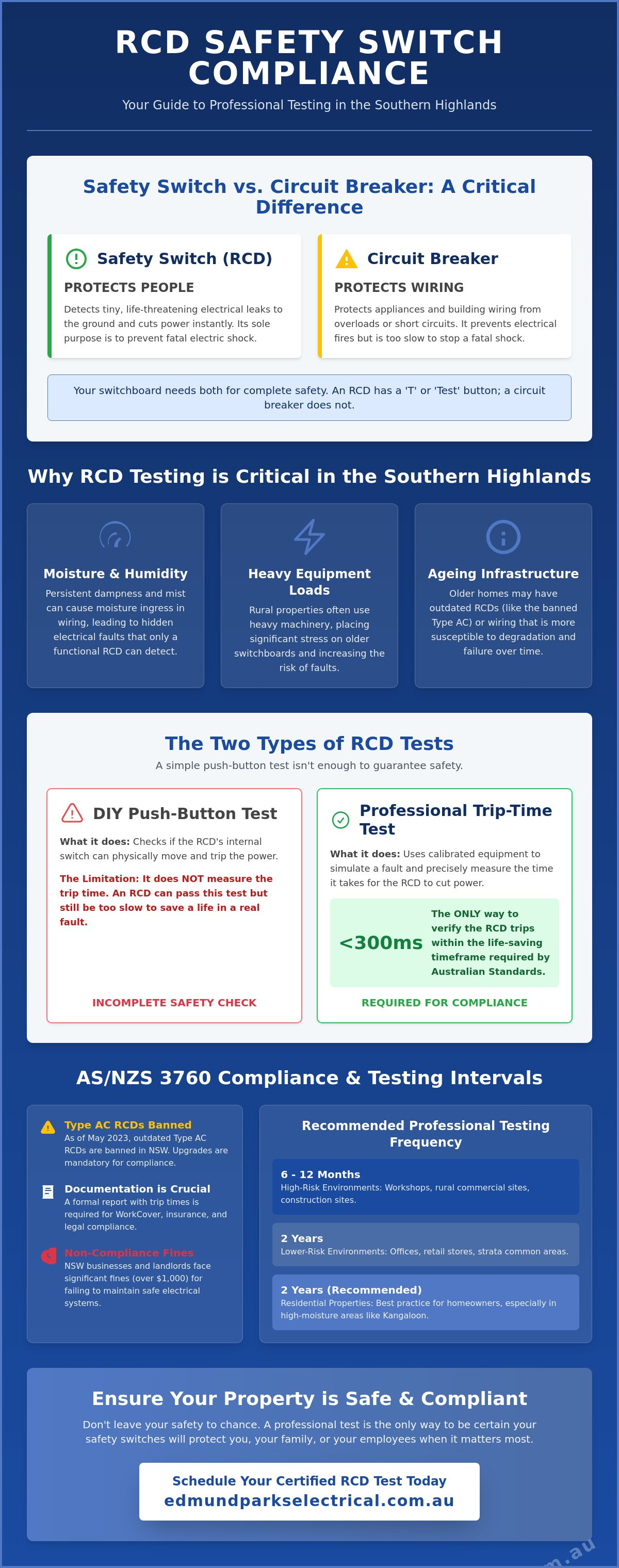
A Residual-current device (RCD) is a sophisticated safety switch designed to prevent serious injury or death from electric shocks. Unlike standard fuses, an RCD monitors the flow of electricity through a circuit. If it detects even a tiny amount of current leaking to the ground, it shuts off the power in under 300 milliseconds. For those living in the Southern Highlands, regular RCD testing Kangaloon is the only way to confirm this mechanism still works at that lightning speed. It's a small device with a massive responsibility.
Kangaloon properties face unique environmental pressures. The persistent mist and high humidity levels in our region can lead to moisture ingress in outdoor power points or shed wiring. This moisture creates "earth leakage," where electricity escapes the intended path. Without a functional RCD, that leaking current could travel through a person instead. Professional testing ensures that environmental wear hasn't compromised the internal components of your safety switches.
The Life-Saving Role of a Safety Switch
Safety switches are your primary defense in high-risk areas like kitchens, bathrooms, and outdoor work sheds. In older Kangaloon homes, it's common to find only one RCD protecting the entire house. Modern safety standards now recommend protecting every individual circuit, including your LED strip lighting and power points. This setup prevents a single fault from plunging your entire home into darkness. It ensures every corner of your property remains safe for your family and guests. Having multiple switches also makes it much easier to identify which specific appliance is causing a trip.
RCD vs. Circuit Breaker: Knowing the Difference
Many homeowners confuse circuit breakers with safety switches. It's a dangerous misunderstanding. A circuit breaker or fuse is designed to protect your home's wiring from overheating and catching fire; it doesn't care about protecting people. An RCD is specifically calibrated to detect the low-level leaks that cause heart failure or muscle paralysis. You can usually spot an RCD on your switchboard by looking for a small button marked with a "T" or the word "Test." If your switches don't have this button, you likely only have circuit protection and are missing critical life-saving technology. Professional RCD testing Kangaloon verifies that these specific human-protection devices are responding within the legal timeframes required to save a life.
Understanding AS/NZS 3760: Mandatory RCD Testing Standards
AS/NZS 3760:2022 is the national benchmark for the safety inspection and testing of electrical equipment. For local business owners and landlords, RCD testing Kangaloon is a non-negotiable legal obligation under the NSW Work Health and Safety (WHS) Regulation 2017. This standard ensures that every safety switch on your property is capable of disconnecting power fast enough to prevent a fatal shock. While the law focuses heavily on commercial settings, these AS/NZS 3760 testing guidelines serve as the gold standard for residential safety too. If your home hasn't been checked lately, you’re essentially guessing about your family’s protection.
The distinction between residential "best practice" and commercial "mandatory compliance" is a narrow one when it comes to insurance. Many modern policies require proof that you’ve taken reasonable steps to maintain a safe electrical environment. Since the May 1, 2023, ban on Type AC RCDs in NSW, having documented evidence of compliance is more critical than ever. Building Commission NSW has already issued over $20,000 in fines for non-compliance with these updated safety regulations. Proper documentation is your only shield during a WorkCover audit or an insurance claim investigation.
Testing Intervals: How Often is Enough?
The required frequency for testing depends entirely on your environment. In higher-risk settings like workshops or rural commercial sites where equipment is moved frequently, professional trip time testing is required every 6 to 12 months. For lower-risk areas like offices or retail spaces, a two-year interval is generally acceptable. For Kangaloon homeowners, we recommend a professional assessment every two years to account for the region's unique moisture levels. Between these visits, you should perform a simple "push-button" test every six months. This doesn't replace a professional check, but it confirms the mechanical components haven't seized up.
Compliance Documentation for Southern Highlands Businesses
A compliant RCD test report is a detailed legal document. It must record the specific trip time of each device, its unique ID, and a clear pass or fail result. Digital record-keeping has become the industry standard, making it easy to track your history and prepare for future safety audits. These reports are often a prerequisite for larger projects, such as energy efficient upgrades Southern Highlands, ensuring that new technology is built on a safe foundation. If you’re unsure whether your current switchboard meets these 2026 standards, a quick professional safety switch review can provide the clarity you need to stay protected and compliant.
Rural Electrical Challenges: Why Kangaloon Needs Professional Oversight
Kangaloon’s rolling hills and frequent mist create a picturesque setting, but they also present a unique set of challenges for your home’s wiring. Unlike suburban environments, rural properties deal with high humidity and moisture levels that accelerate the degradation of electrical components. Regular RCD testing Kangaloon is essential because environmental moisture often leads to "sticky" safety switches. These devices might look perfectly fine to the naked eye, but internal corrosion can prevent them from tripping when a fault occurs. When you're managing a working farm or a large acreage, you can't afford to guess whether your safety systems are operational. It's a simple check that prevents a major disaster.
Pests are another major factor in the Southern Highlands. Vermin like mice and rats often find their way into outdoor sheds or sub-floor spaces, where they chew through cable insulation. This damage causes intermittent earth leakage that can be incredibly difficult to track down without specialized equipment. Our rural electrical services are designed to handle these specific issues. We manage everything from protecting long cable runs to automatic gates and bores to ensuring your livestock fencing doesn't interfere with your household power. We understand the local terrain and the common failures that occur in our specific climate.
Moisture and Corrosion in Outdoor Switchboards
Kangaloon’s climate is notorious for causing premature mechanical failure in outdoor switchboards. If moisture enters the enclosure, it can gum up the delicate springs inside an RCD. This creates a "sticky" switch that fails to disconnect power during a surge or fault. We pay particular attention to pump circuits and electric fencing components during a safety audit. These systems are often exposed to the elements and are prime candidates for electrical faults. These faults could lead to fires or shocks if the RCD fails to act within the required 300 milliseconds.
Solving Nuisance Tripping in Older Properties
Few things are more frustrating than a power outage that happens for no apparent reason. In older rural properties, nuisance tripping is often caused by a single "master" safety switch being overloaded by modern appliances or a "leaky" old welder in the shed. We solve this by recommending switchboard upgrades that include multiple RCBOs. This setup ensures that a fault in the back paddock won't cut the lights in your kitchen. Our diagnostic tools allow us to pinpoint these intermittent faults quickly. We find the source of the leak without tearing apart your walls or ceilings, providing a fast and efficient remedy for your peace of mind.
The Professional RCD Testing Process: Beyond the Push-Button
Many homeowners believe that pressing the "test" button on their switchboard once a year is enough to guarantee safety. It isn't. That little button only confirms that the mechanical latch can move. It tells you nothing about how fast the switch will actually trip when a human life is on the line. Professional RCD testing Kangaloon involves using specialized, calibrated instruments to simulate a real-world electrical fault. We need to ensure the device is sensitive enough to react before electricity causes permanent physical harm. This level of precision is a standard part of any switchboard upgrade Bowral, giving you a baseline of safety that a simple manual check cannot provide.
Step 1: Visual Inspection and Mechanical Test
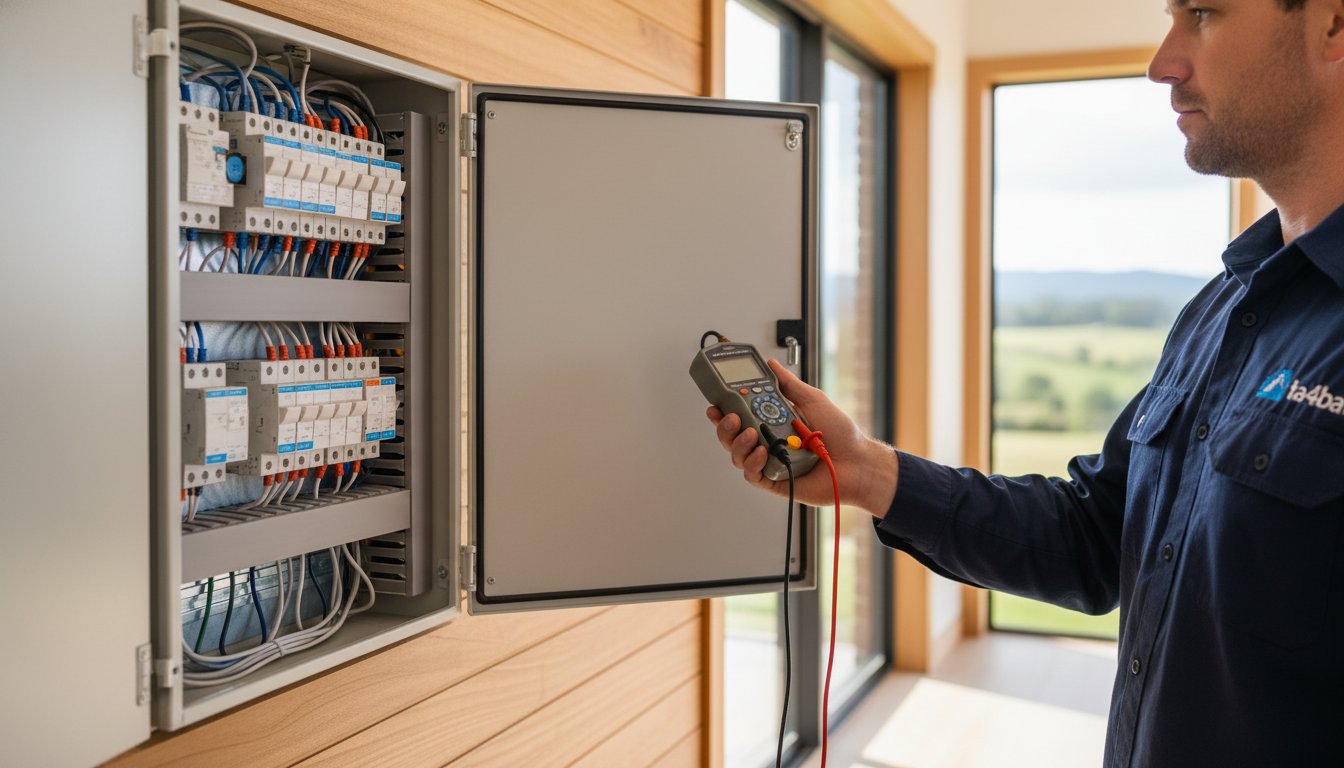
Our process begins with a thorough visual inspection of your entire switchboard. We look for tell-tale signs of trouble like heat discolouration, melted insulation, or loose terminal connections. In the Southern Highlands, we often find evidence of moisture ingress or insect nests that can compromise electrical components. We then perform the manual push-button test to ensure the internal mechanism hasn't seized up from lack of use. Finally, we verify that every circuit is correctly labelled. In an emergency, you don't want to be guessing which switch isolates the power to your kitchen or workshop.
Step 2: Trip-Time Injection Testing
This is the technical heart of the safety audit. We use a calibrated RCD tester to "inject" a controlled 30mA earth leakage fault into the circuit. Our equipment measures the exact response time in milliseconds. While the legal safety limit is 300ms, a healthy modern switch should trip in under 40ms. We perform this test at both the 0-degree and 180-degree phases of the electrical wave. This ensures the device reacts perfectly regardless of where the fault occurs in the AC cycle. If a switch takes too long to trip, it's a failure, and we'll recommend an immediate replacement to keep you protected.
Step 3: Certification and Reporting
Once your switches pass the speed test, we apply high-visibility compliance tags to the switchboard. These tags provide a clear visual record for you, your tenants, or any future safety inspectors. We also issue a comprehensive digital safety report that includes specific trip times and device IDs for your property records. This documentation is vital for your insurance compliance and provides total peace of mind that your home meets 2026 standards. Trip-time testing is the only way to verify RCD sensitivity and ensure your safety switches are more than just a decoration. Ready to secure your home? Book your professional safety switch check today.
Why Choose Edmund Parks Electrical for RCD Testing in Kangaloon?
Choosing a local tradesperson is about trust and accountability. When you book RCD testing Kangaloon with us, you're getting an expert who understands the specific environmental demands of the Southern Highlands. We've spent years servicing properties from the mist-heavy hills of Kangaloon to the residential streets of Bowral. We know exactly how the local climate affects your wiring over time. Our team takes a no-nonsense approach to every job. We don't just identify faults; we fix them. If a safety switch fails our trip-time test, we'll provide an immediate remedy to keep your family or business protected. We believe in leaving every property safer than we found it.
Knowing how to hire an electrician in the Southern Highlands who actually cares about your safety is the first step toward a secure home. We pride ourselves on being punctual, honest, and easy to talk to. Our technicians are fully licensed and insured, bringing technical competence and a friendly neighborly attitude to every site visit. You won't find any hidden "rural call-out" fees or surprise costs in our transparent quoting. We value our reputation in this community and believe in straightforward pricing for high-quality work.
Professional Credentials and Local Reliability
Reliability is the backbone of our business. We understand that your time is valuable, so we arrive when we say we will. As a proud local business, we're familiar with the unique needs of Highlands residents, from managing aging farm switchboards to installing modern LED strip lighting. Our technicians are trained in the latest AS/NZS 3760:2022 standards. We use the most advanced calibrated testing equipment available. This ensures your compliance documentation is bulletproof and your property remains fully protected against electrical faults.
Complete Electrical Safety Solutions
Our services go far beyond simple compliance checks. We offer a holistic approach to safety by combining RCD testing with smoke alarm checks and comprehensive switchboard audits. If your board is still running on old-fashioned fuses or outdated Type AC switches, we'll provide expert advice on upgrading to RCBOs for superior circuit protection. This modern technology offers the highest level of safety for your power points and lighting circuits. Ensuring your property is safe shouldn't be a stressful process. Book your RCD safety test with Edmund Parks Electrical today and let us handle the technical details while you enjoy total peace of mind.
Secure Your Property for the Years Ahead
Electrical safety isn't something you can set and forget. We've explored how the unique climate of the Southern Highlands can compromise your safety switches without warning. From moisture in outdoor switchboards to the strict requirements of the AS/NZS 3760 standards, professional RCD testing Kangaloon is your only way to ensure your family or business remains truly protected. A simple push-button test is a great start, but it can't replace the precision of trip-time injection testing conducted by a professional.
Since 2018, we've been proudly serving the Southern Highlands as fully licensed NSW electricians and AS/NZS 3760 compliance specialists. We're here to help you move from being unsure about your electrical safety to having total peace of mind. Whether you're running a local business or managing a quiet rural home, we'll ensure your safety switches are ready to act when they're needed most. Secure Your Home with Expert RCD Testing in Kangaloon today. Your safety is our priority, and we're ready to help you stay compliant and secure.
Frequently Asked Questions
What is the difference between an RCD and a safety switch?
An RCD and a safety switch are exactly the same thing. RCD stands for Residual Current Device, which is the technical name used by electricians and in the Australian Standards. While "safety switch" is the common term used by homeowners, both refer to the device that monitors current and prevents fatal shocks by cutting power during a leak.
How often do I legally need to test RCDs in a commercial building in NSW?
Testing intervals are determined by the risk level of your specific environment under AS/NZS 3760:2022. High-risk areas like workshops or construction sites require professional trip-time testing every 6 to 12 months. For lower-risk office spaces, the standard generally requires testing every 2 years to maintain compliance with NSW Work Health and Safety regulations.
Can I test my own safety switches or do I need an electrician?
You can and should perform the manual push-button test every six months, but you still need a licensed electrician for the mandatory speed test. Only a professional has the calibrated equipment needed to measure the exact trip time in milliseconds. Professional RCD testing Kangaloon ensures your switches are sensitive enough to save a life, not just mechanically functional.
Why does my safety switch keep tripping when it rains in Kangaloon?
Rain and high humidity often cause "nuisance tripping" by entering outdoor power points, garden lights, or pump motors. This moisture creates a path for electricity to leak to the ground, which your RCD correctly identifies as a fault. If your power trips every time the mist rolls in, it's a sign that an outdoor circuit has a compromised seal or damaged insulation.
Does RCD testing require the power to be turned off?
Yes, we have to momentarily turn off the power to each circuit during the testing process. Because the test involves simulating a real fault to see how the switch reacts, the RCD must trip and cut the power. We work efficiently to ensure these disruptions only last a few seconds per circuit, so your daily routine isn't heavily impacted.
What happens if my RCD fails the trip-time test?
If a safety switch fails to trip within the required 300 milliseconds, it is considered faulty and must be replaced immediately. A slow-reacting switch won't disconnect the power fast enough to prevent serious injury or heart failure during a shock. We carry high-quality replacements to fix these issues on the spot, ensuring your property remains safe and compliant.
Are old switchboards without RCDs illegal in Kangaloon homes?
Old switchboards without RCDs aren't illegal to own, but they are no longer compliant with modern Australian safety standards. If you carry out any new electrical work, such as adding a new power point or circuit, you are legally required to install RCD protection. Upgrading your board is a smart investment that brings your home up to 2026 safety benchmarks, a practice mirrored by professional firms like Triumph Electrical Contracting Inc. when modernizing commercial and residential systems.
How much does a professional RCD testing service cost?
The cost of RCD testing Kangaloon varies based on the size of your switchboard and the number of circuits that need verification. Every property is different, so we provide tailored quotes rather than a one-size-fits-all price. This ensures you receive a fair rate for the specific number of safety switches in your home, office, or rural workshop.